Motorcycle Racing: From Flat Tracks to MotoGP
Introduction: Racing Is in the Blood
From the moment motorcycles roared to life, riders have been lining up to see who’s fastest. Racing isn’t just competition — it’s in the DNA of motorcycling. It’s about courage, precision, and the primal thrill of speed.
From small-town dirt ovals to billion-dollar MotoGP circuits, motorcycle racing comes in many forms — each with its own heroes, culture, and adrenaline. But no matter the track, the heart of racing is always the same: the bond between man, machine, and motion.
Flat Track Racing – The American Classic
Few things feel more American than the rumble of V-twins sliding through dirt turns.
The Setup: Riders battle on oval dirt tracks, drifting sideways in close formation.
The Vibe: Gritty, raw, and stripped down — where skill, not money, makes champions.
Famous Racers: Scott Parker, Jared Mees, and Shayna Texter-Bauman carried flat track’s torch across generations.
Born from county fairs and local ovals, flat track racing remains the soul of grassroots motorcycle competition — a celebration of courage, control, and community.
Board Track Racing – The Dangerous Past
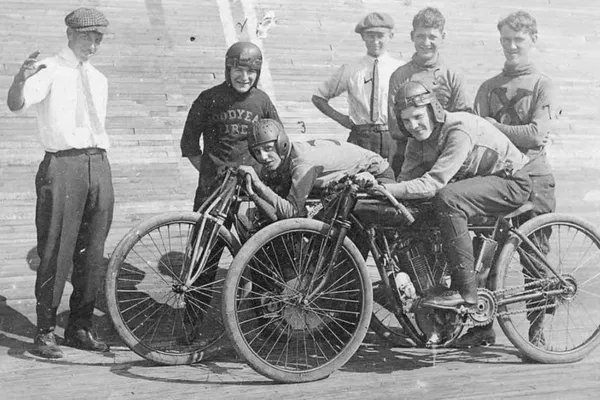
In the early 1900s, racing took place on wooden “motordromes” — massive banked ovals made of timber planks.
The Danger: Bikes with primitive brakes hit speeds over 100 mph on tracks that splintered and burned. Crashes were brutal and often fatal.
The Legacy: Though short-lived, board track racing helped make motorcycles famous and fueled America’s love for speed.
Today, it stands as a reminder of the fearless riders who risked everything in the name of competition.
Road Racing – The Rise of MotoGP
Road racing grew from simple public-road challenges into the world’s most elite motorcycle championship: MotoGP.
MotoGP Today: The fastest bikes on Earth, purpose-built for performance, reaching speeds over 220 mph.
Legends: Valentino Rossi, Marc Márquez, and Giacomo Agostini — riders whose names echo through history.
Technology: MotoGP bikes are testbeds for the future — where innovations like traction control, ABS, and aerodynamics are born.
It’s more than racing; it’s a global spectacle. Every lean, every apex, every millisecond defines the pursuit of perfection.
The Isle of Man TT – The Ultimate Test
The Isle of Man Tourist Trophy (TT) isn’t a race for everyone — it’s a race for legends.
The Course: 37 miles of twisting public roads through villages, fields, and mountains.
The Speed: Riders average over 130 mph — inches from stone walls and curbs.
The Risk: With over 250 lives lost since 1907, it remains the most dangerous race in the world.
For those who face it, the TT isn’t just a challenge — it’s a calling. Conquering it earns eternal respect in the riding community.
Drag Racing – The Quarter-Mile Thrill
Pure acceleration. No corners. No strategy. Just man, machine, and reaction time.
The Setup: Two bikes line up for a ¼-mile sprint — whoever crosses first, wins.
The Machines: Everything from street-legal cruisers to nitro-fueled beasts producing over 1,500 horsepower.
The Culture: Drag strips are where ordinary riders become local heroes, pushing physics to its limit every weekend.
Drag racing proves that speed isn’t about distance — it’s about power and precision in the blink of an eye.
Motocross and Supercross – The Dirt Kings
Off-road racing brings a new kind of chaos — one made of mud, jumps, and heart-pounding airtime.
Motocross: Natural outdoor tracks with hills, bumps, and unpredictable terrain.
Supercross: Stadium-based racing with massive jumps and tight technical turns.
Heroes: Ricky Carmichael, Jeremy McGrath, and Eli Tomac — names that define grit and glory.
Motocross is where champions are born young. Many start at five years old — racing, crashing, and learning resilience with every lap.
Endurance Racing – The Long Haul
Endurance races push riders and machines to their limits — and beyond.
Famous Races: 24 Hours of Le Mans (motorcycles), Suzuka 8 Hours, Bol d’Or.
The Challenge: Teams rotate riders through day and night, managing fatigue, strategy, and mechanical survival.
The Spirit: Victory isn’t about speed alone — it’s about teamwork, consistency, and unbreakable focus.
In endurance racing, it’s not the fastest who wins — it’s the toughest.
Why Racing Matters to Motorcycle Culture
Racing is more than competition — it’s the heartbeat of motorcycle evolution.
🏁 Innovation: Technologies like disc brakes, ABS, and traction control were born on the track.
🧍♂️ Heroes: Racers become legends who inspire generations of riders.
🤝 Brotherhood: Racing brings riders together, from local dirt tracks to world championships.
🎉 Spectacle: Whether at Daytona, Mugello, or a hometown flat track, racing celebrates the essence of riding — passion and performance.
The culture of racing is the culture of pushing limits, sharing victories, and respecting those who dare to go faster.
Final Thoughts: Speed, Risk, and Glory
Motorcycle racing captures everything riders love — freedom, adrenaline, and community. Whether it’s the roar of flat track engines, the scream of MotoGP machines, or the silence before a drag race light turns green, it all speaks to one truth:
Riders were born to push boundaries.
From dusty fairgrounds to world-class circuits, motorcycle racing continues to honor that instinct — the need to chase perfection at full throttle.
👉 Have you been to a motorcycle race? Share your stories, photos, and racing memories on the Ride Nation USA Facebook page.
👉 And if your ride — on or off the track — ever takes a bad turn, NAMIL.org connects you with attorneys who ride and fight for bikers everywhere.