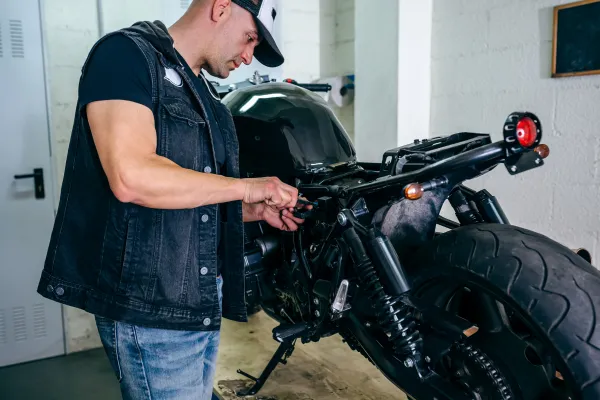
The Flexitarian Approach to Motorcycle Maintenance (Or: How I Learned to Love the Wrench)
Hey, folks — life's short, throttle's long, and my attention span's somewhere near the next exit.
Today I need to talk about something that divides the motorcycle community into two angry camps that spend way too much time arguing on the internet.
Maintenance.
You've got the purists who insist you're not a real rider unless you rebuild your engine blindfolded using only a butter knife and spite. Then you've got the folks who think touching anything on their bike requires a dealership appointment and a second mortgage.
I'm neither.
I'm what I call a "flexitarian" when it comes to maintenance. I borrowed the term from eating habits — you know, people who eat mostly vegetarian but also enjoy a burger. Flexibility. Options. Common sense.
Same approach to motorcycle maintenance. I'll eat vegetables, but I'm also having that burger. I'll change my oil, but I'm not rebuilding my transmission.
Flexibility. Options. Common sense. The hallmarks of aging gracefully and not going broke maintaining a motorcycle.
The DIY vs Professional Divide
Here's what I've learned over 40+ years: some things you should do yourself, some things you should pay someone to do, and knowing the difference is what separates smart riders from broke riders with greasy hands and regret.
Let me break it down.
Things I Do Myself
Oil Changes
Easy. Cheap. Satisfying. You need a drain pan, some wrenches, and 30 minutes. If you can't change your own oil, you probably shouldn't be operating machinery.
Harsh? Maybe. True? Definitely.
An oil change at a shop costs $80-100. DIY costs $30-40 in materials. That's a $50 savings for 30 minutes of work. That's $100/hour. Show me another job that pays that well for such simple work.
Plus, you learn your bike. You see what's under there. You notice leaks, loose bolts, worn parts. You build a relationship with the machine.
Chain Maintenance
Clean it. Lube it. Adjust it. This isn't rocket science. It's barely earth science.
YouTube exists. Watch a video. Do it yourself. Your bike will thank you by not making that horrible grinding noise that tells everyone within a mile that you don't maintain your chain.
A dirty, dry chain wears out fast. Costs $200-300 to replace. Ten minutes every 500 miles to clean and lube it? That's cheap insurance.
Tire Pressure
Get a gauge. Check it weekly. This takes 2 minutes and prevents roughly 1,000 problems.
Wrong tire pressure affects handling, wear, fuel economy, and safety. It's literally one of the most important things you can check, and it takes less time than making coffee.
Yet I see riders who never check. Then they wonder why their tires wear funny or their bike handles weird. Check your tire pressure. Be smarter than that.
Brake Pad Inspection
Look at them. If they're thin, replace them or have someone replace them. You don't need a degree to see when something's worn down to nothing.
Brakes are kind of important. Like, really important. Check them regularly. Know what worn pads look like. Don't ride on metal-on-metal because you were too lazy to look.
Cleaning
I know, this sounds obvious. But a clean bike is a bike you notice problems on. Dirt hides cracks, leaks, and issues. Spend 20 minutes washing your bike, and you'll spot things before they become expensive things.
Plus, clean bikes just run better. I can't explain it scientifically, but it's true. A clean bike is a happy bike.
Things I Pay Someone to Do
Valve Adjustments
This requires patience, precision, and tools I don't own. Could I learn? Sure. Do I want to? Absolutely not.
I'd rather pay $300 and know it's done right than spend six hours cursing while covered in oil, only to discover I did it wrong and now my engine sounds like a sewing machine full of rocks.
Some jobs are worth outsourcing. This is one of them.
Electrical Issues
Wiring is dark magic. I don't trust it. I don't understand it. When something electrical goes wrong, I hand it to someone who speaks that language and accept my fate.
I've tried fixing electrical problems. It always ends badly. Wires everywhere. Nothing works. More problems than when I started. Now I just pay someone and save myself the frustration.
Suspension Work
Too many things can go wrong. Too many specialized tools needed. Not worth the risk of screwing it up and ruining my ride quality for the next year.
Suspension affects everything about how a bike handles. When it needs work, I pay someone who does this for a living.
Anything Involving the Transmission
Hard pass. I respect people who can do this. I am not those people. I will pay money to not be those people.
Transmissions are complex. Lots of parts. Lots of ways to screw it up. I know my limits. This exceeds them.
Major Engine Work
Look, I like my bike. I want it to run. I don't want to discover I'm missing a bolt somewhere important because I got distracted halfway through reassembly and thought, "That's probably fine."
Because it's never fine. That bolt was there for a reason.
Major engine work goes to professionals. People who do this daily. People who won't forget critical parts.
The Philosophy of Knowing Your Limits
The trick is knowing your limits without letting ego get involved.
Too many riders think doing your own maintenance is some badge of honor. Like you're not a "real" rider if you pay a mechanic. That's nonsense.
You know what's real? A bike that runs properly. How it got that way doesn't matter.
I've got friends who can rebuild an engine on their kitchen table. Good for them. That's a skill. I'm impressed.
I've got other friends who've never touched a wrench and still ride 20,000 miles a year. Also good. They know what they know, and they know what they don't know.
Both are valid approaches.
I'm somewhere in the middle. Flexitarian. I'll do what makes sense, pay for what doesn't, and sleep well knowing my bike's in good shape either way.
Learning Curve and When to Expand
Here's my advice: start with the easy stuff. Oil changes. Chain lube. Cleaning. Get comfortable with basic maintenance. Watch videos. Read your manual — yes, that book that came with your bike actually contains useful information. Who knew?
Then slowly expand your skills. Maybe brake pads next. Maybe coolant flush. Maybe tire changes if you're feeling ambitious and have the tools.
But know when to stop. Know when you're out of your depth. Saving $200 on a repair isn't worth ruining a $10,000 bike.
The Learning Story
Remember the time I decided I could adjust my own carburetor? That was a mistake. A $400 mistake, once I paid someone to fix what I broke.
Learned my lesson. Some things are worth outsourcing.
But I also remember the time I paid a shop $80 to change my air filter. Something that takes 5 minutes and costs $20 in parts. Never again.
That's how you learn. Make mistakes on small stuff. Don't make mistakes on big stuff.
Balance.
What Nobody Talks About
And here's the thing nobody talks about: doing your own maintenance teaches you how your bike works. You understand it better. You notice problems earlier. You build a relationship with the machine.
But that doesn't mean you have to do everything yourself.
You can understand how an engine works without rebuilding one. You can appreciate good suspension without setting it up yourself. You can be a knowledgeable rider without being a mechanic.
The goal isn't to prove something. The goal is to ride. Everything else is just logistics.
The Cost-Benefit Analysis
Let's talk money. Because that's ultimately what this comes down to for most people.
Oil change: $30 DIY vs $80 shop. Worth doing yourself.
Chain adjustment: $5 DIY vs $40 shop. Worth doing yourself.
Valve adjustment: $50 in tools (if you have them) + 3 hours vs $300 shop. Pay the shop.
Tire change: $100 in tools + frustration vs $40 shop. Pay the shop unless you change lots of tires.
Do the math for each job. Factor in time, tools, skill level, and risk of screwing it up. Make smart decisions, not emotional ones.
The Social Pressure
Don't let anyone shame you for paying a mechanic. Don't let anyone shame you for doing it yourself.
Just do what works for you, your skill level, and your comfort zone.
I've seen riders spend money they don't have on tools they'll never use again because they felt pressured to do everything themselves. That's stupid.
I've also seen riders pay for simple jobs they could easily learn because they're intimidated by mechanical stuff. That's also unnecessary.
Find your middle ground. Be honest about your abilities. Make smart choices.
The Final Word
So don't let anyone shame you. The goal isn't to prove something. The goal is to ride.
Flexitarian maintenance. Do what you can. Pay for what you can't. Keep your bike running. Keep yourself happy.
That's all that matters.
Later, folks — keep your oil fresh and your ego in check.
DIY or dealership? Share your maintenance philosophy on Ride Nation USA's Facebook page. Let's learn from each other and stop judging each other's choices.
SAFETY NOTE:
Regular maintenance isn't just about performance — it's about safety. Neglected bikes cause accidents. Brake failure, tire blowouts, and mechanical problems can lead to serious crashes. If you've been injured due to someone else's poor vehicle maintenance or a mechanical failure caused by negligent service, you may have a case. Contact a motorcycle injury attorney who can investigate the cause and help you get compensation.