The $2,000 I Spent on Gear That Saved My Life (And Why Cheap Gear is Expensive)
Hey, folks — life's short, throttle's long, and my attention span's somewhere near the next exit.
But today we're talking about something that kept my attention span from ending permanently about three years ago.
Gear.
Specifically, the $2,000 worth of gear I was wearing when some guy in a pickup truck decided red lights were optional and I became very intimate with Florida asphalt at 45 mph.
I walked away. Sore, angry, covered in road rash on my arms where my jacket rode up, but fundamentally intact. No broken bones. No head injury. No hospital stay. Just a totaled bike, shredded gear, and a very expensive lesson about why quality matters.
That gear cost $2,000. Saved my life. Best money I ever spent. And I didn't even know it at the time.
The Cheap Gear Fallacy
Let me start with something controversial: if you can't afford good gear, you can't afford to ride.
Harsh? Maybe. True? Absolutely.
I see riders all the time on $15,000 bikes wearing $200 worth of gear. Fifty-dollar helmets. Thin textile jackets that wouldn't stop a mosquito. Regular jeans. Sneakers. Maybe gloves if they remembered.
They spent more on their exhaust system than their helmet. More on chrome than protection. More on making the bike look good than making themselves stay alive.
That's backwards. Dangerously backwards.
Your bike doesn't protect you. Your gear does. The bike is what gets you into accidents. The gear is what gets you out of them.
What I Learned the Hard Way
Three years ago, I was riding through Tampa. Morning commute. Light traffic. I'd ridden this route a thousand times.
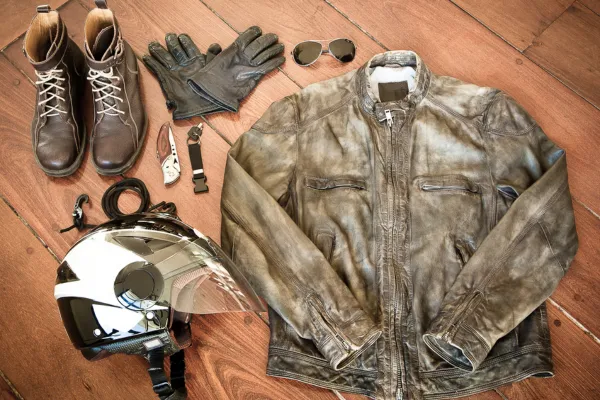
I was wearing:
$600 Arai helmet
$500 leather jacket with CE-rated armor
$200 gloves with knuckle protection
$300 riding boots
$400 kevlar-reinforced riding pants
Total: $2,000 in gear. Which felt ridiculous when I bought it. My wife definitely thought it was ridiculous. "It's just gear," she said. "Do you really need the expensive stuff?"
Yes. As it turns out. Very much yes.
Light turned green. I started through the intersection. Pickup truck ran the red light. Didn't slow down. Didn't even try to stop. Just plowed through like traffic laws were suggestions.
He hit me. I went down. The bike slid one way, I slid the other. Forty-five miles per hour to zero in about three seconds. All the physics you don't want to experience.
The helmet hit first. Then my shoulder. Then I was sliding on my back, watching the sky rotate. Then I stopped.
Everything hurt. My ribs. My shoulder. My hip. My pride. But I was conscious. I was thinking clearly. I could move everything. Nothing was broken.
The jacket took most of the impact. Shoulder armor absorbed the initial hit. Back armor protected my spine. The leather held up against the asphalt for the entire slide.
The pants saved my legs. The kevlar reinforcement did exactly what it was supposed to do. No road rash. No damage. Just bruising from the impact.
The boots protected my ankles. The gloves saved my hands. The helmet kept my brain inside my skull where it belongs.
I stood up. Walked to the curb. Called 911. Gave a statement. Went home that night.
The gear? Destroyed. Completely shredded. The jacket had torn through in places. The pants were scraped raw. The gloves had holes. The helmet had cracks and scratches. Everything went in the trash.
But I went home. That's what $2,000 bought me.
The Real Cost of Cheap Gear
Here's what cheap gear costs:
A fifty-dollar helmet might be DOT certified. Might pass the minimum legal requirements. But it's not going to protect you like a $600 helmet. The shell is thinner. The liner is cheaper. The chin bar is weaker. The retention system is less secure.
You get what you pay for. And what you're paying for is your brain.
A hundred-dollar jacket looks like a motorcycle jacket. Has the style. Has pockets. Maybe even has padding in the shoulders and elbows.
But it's not going to hold up in a slide. The material is thinner. The stitching is weaker. The armor is minimal. It'll tear through in seconds, and then you're sliding on skin.
Regular jeans seem fine until you're sliding on asphalt at 40 mph. They last about half a second. Then it's your skin on the road. Denim is not protective. It's just cotton. It burns through instantly.
Sneakers are even worse. Your ankles, feet, toes — all vulnerable. One wrong impact and you're looking at crushed bones, torn tendons, permanent damage.
What Quality Gear Actually Does
Quality gear is engineered. Tested. Certified. Designed by people who understand impacts, abrasion, and human anatomy.
Quality Helmets:
Multi-density foam liners that absorb different impact forces. Stronger shells that distribute impact. Better retention systems that keep the helmet on your head. Superior ventilation that keeps you comfortable so you actually wear it.
My Arai cost $600. It had multiple impacts during my accident. Absorbed all of them. Protected my head completely. Worth every penny.
I replaced it with another Arai. Same price. Same quality. Same peace of mind.
Quality Jackets:
CE-rated armor in shoulders, elbows, back. Thick leather or textile that can handle slides. Quality stitching that holds together under stress. Proper fit that stays in place during impact.
My jacket cost $500. It took a beating. Saved my shoulders, elbows, and back from serious damage. The armor did exactly what it was supposed to do.
When I replaced it, I spent $600. Got even better armor. Even better protection. No regrets.
Quality Pants:
Kevlar or leather reinforcement in impact zones. CE-rated knee and hip armor. Proper construction that doesn't tear. Fit that stays put during slides.
My pants cost $400. They protected my legs and hips completely. No road rash. No damage. Just the bruising you can't avoid.
Replacement cost me $450. Upgraded to better armor. Better fit. Better protection.
Quality Gloves:
Knuckle protection. Palm sliders. Reinforced seams. Materials that don't tear. Fit that stays secure.
My gloves cost $200. They saved my hands. Took most of the impact during the slide. Kept me from losing skin.
New gloves cost $220. Worth it.
Quality Boots:
Ankle protection. Toe protection. Shin protection. Materials that hold up. Construction that doesn't fail.
My boots cost $300. They protected my feet and ankles completely. No damage. No injuries.
Replacement boots cost $350. Better protection. Better quality. No hesitation.
The Math That Matters
Here's the math people don't think about:
Cheap gear: $500 total
$75 helmet
$150 jacket
$50 gloves
$100 boots
$125 regular jeans
Hospital bill after accident: $50,000+
Emergency room
X-rays, CT scans
Surgery for broken bones
Physical therapy
Lost work time
Ongoing medical issues
Quality gear: $2,000 total Hospital bill after accident: $0 Time lost to injuries: Minimal Long-term complications: None
Which is the better investment?
What to Actually Buy
I'm going to tell you exactly what to buy. Not brands — though I have opinions — but what features matter. What to look for. What not to compromise on.
Helmet: $400-800
Get Snell or ECE certified, not just DOT. DOT is the minimum. You want better than minimum.
Get a full-face helmet. Your face is worth protecting. Half helmets are stupid. Three-quarter helmets are slightly less stupid. Full-face or nothing.
Get a helmet that fits properly. Go to a shop. Try them on. Different brands fit different head shapes. Find your shape.
Replace it after any impact. Even minor ones. Replace it every 5 years regardless. The materials degrade over time.
Jacket: $400-700
Get CE-rated armor in shoulders, elbows, and back. CE Level 2 if possible. This is what absorbs impacts.
Get leather or quality textile. Leather is more abrasion-resistant. Quality textile can be better in hot weather. Both work if they're quality.
Get proper fit. Too loose and it shifts during impact. Too tight and it's uncomfortable so you won't wear it. Find the middle.
Get a jacket that connects to your pants. Prevents it from riding up and exposing skin.
Pants: $300-500
Get kevlar or leather protection in slide zones. Knees, hips, seat. These are what hit the ground.
Get CE-rated armor for knees and hips. Same as the jacket. This absorbs impacts.
Get proper fit. Same as jacket. Too loose shifts, too tight is uncomfortable.
Do not ride in regular jeans. They offer zero protection. Zero. Get riding jeans at minimum. Get proper pants ideally.
Gloves: $150-250
Get knuckle protection. Hard armor. Your knuckles hit things. They need protection.
Get palm sliders. They help in slides. They prevent your hands from gripping the ground and breaking your wrists.
Get quality materials that don't tear. Leather or quality textile with reinforcement.
Get proper fit. Gloves that don't fit are dangerous. They affect your control.
Boots: $250-400
Get ankle protection. Minimum. Ankles are fragile. Protect them.
Get boots that cover your shin. More protection is better.
Get quality materials and construction. They need to stay together during impacts.
Get boots with non-slip soles. You need grip on footpegs and ground.
Do not ride in sneakers. Do not ride in regular shoes. Get motorcycle boots.
The Excuses I Keep Hearing
"I can't afford it."
You can't afford not to. One accident without proper gear costs more than a lifetime of quality gear. Medical bills, lost work, permanent injuries — all preventable with proper protection.
Buy used gear if necessary. Buy last year's models on sale. Buy one piece at a time. But buy quality.
"It's too hot."
Get mesh gear. Get perforated leather. Get textile with vents. Quality gear comes in hot-weather versions.
Being hot is uncomfortable. Road rash is worse. Choose accordingly.
"I look like a Power Ranger."
Who cares? You're on a motorcycle. Looking cool is not the priority. Staying alive is the priority.
Besides, gear looks cool now. Modern riding gear is stylish. You can look good and be protected. It's not 1985 anymore.
"I'm just going down the street."
Most accidents happen close to home. Most accidents happen on routine rides. The accident doesn't care if you're "just going down the street."
Gear up every time. No exceptions.
What I Tell New Riders
Buy the best gear you can afford. Then stretch your budget a little more. This is not where you save money.
Your bike can be cheap. Your bike can be old. Your bike can be ugly. But your gear needs to be quality.
I'd rather see someone on a $2,000 bike with $2,000 in gear than on a $20,000 bike with $200 in gear.
The bike gets you into trouble. The gear gets you out of it.
Three Years Later
I still have the photos of my destroyed gear. Jacket torn through. Pants shredded. Gloves with holes. Helmet cracked.
I look at them sometimes. Reminder of what could have happened. Reminder of why I spend money on gear. Reminder that I'm lucky.
That accident should have been worse. Should have been much worse. Would have been much worse with cheap gear.
Instead, I walked away. Sore but intact. Angry but alive. Expensive but worth it.
And I learned a lesson I'll never forget: gear is not an expense. It's an investment. The best investment a rider can make.
Later, folks — protect your body, protect your future, protect your ability to keep riding.
What gear has saved you? Share your gear story on Ride Nation USA's Facebook page. Let's remind each other why quality gear matters and help new riders make smart choices.
SAFETY NOTE:
Quality gear reduces injuries, but it can't prevent all accidents. If you're hit by a negligent driver even while wearing proper safety equipment, you still deserve full compensation for your injuries, bike damage, and gear replacement. Insurance companies sometimes try to blame riders for "choosing" to ride — don't let them.Connect with a motorcycle injury attorney who understands rider rights and will fight for every dollar you deserve, including the cost of replacing destroyed safety gear.